BUILDING LIGHT
by Clay Ramskill
Okay, so we all know that we want our planes to be as light as possible. How do we do that, especially with a kit already in hand?
WOOD: The first and primary rule is -- do NOT use heavy wood!!! Select your wood at the hobby shop. Get good, straight grained balsa pieces and compare them -- then buy the lightest. If you buy mail order, get contest balsa (4-6#) or "light" (6-8#) wood and hope for the best.
With a kit, you may have to throw out some wood and replace the heaviest stuff with lighter stock.
GLUE: Use light glue -- CA is the best for the weight, aliphatics come next, and epoxies are the worst. Where you feel you must use epoxy, such as on your firewall or landing gear blocks, use as little as possible.
PLY: Plywood is heavy, but necessary in some spots -- firewalls, landing gear plates, and some formers need to be ply. But use it sparingly, substituting lite ply or even balsa ply if you can. But where bolts are involved, you should use aircraft ply.
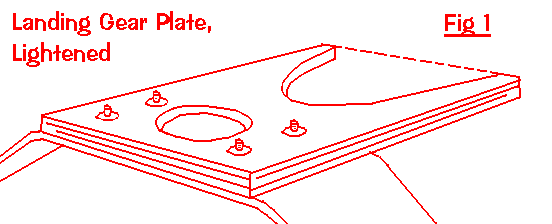
Even using the heavier ply, we can shave some weight. For instance, 3/16" ply is enough for most 40-size firewalls and landing gear plates. Throw out the 1/4" stuff.
Further, use the strength of the engine mount. If it's a
one-piece mount, you don't need the wood inside the bolt pattern.
Cut it out, stuff the hole with balsa. The same goes for a plate
for mounting landing gear. [See Fig. 1]
Wing mounting blocks can be cut down -- moving the bolts back an inch may allow you to cut an inch off the front of the blocks.
Ply formers can usually be trimmed from the inside, ply fuselage sides can usually stand larger lightening holes.
CUT AND CHOP: Lightening holes can be cut in balsa fuselage sides and on the top. (You may want to keep the fuselage bottom solid.) Thinner balsa may often be used for top and bottom cross-grain planking. Hollow or eliminate large blocks, such as are often supplied for wingtips.
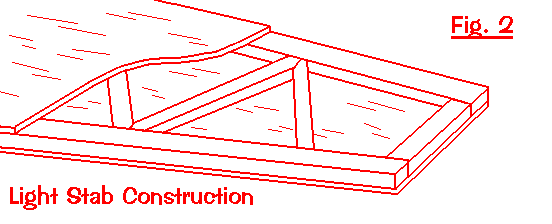
BUILD UP: Ailerons, rudders, and fins/stabs may be heavy 1/4" - 5/16" solid balsa. Building these up from 1/16" balsa skins with trusswork interiors gives you a light, stiff structure, perhaps even stronger than the originals. Building up these surfaces may also be preferable to using the original solid wood with lightening holes. Skinned "built ups" are considerably stiffer than open frame construction, but not as light. [See fig. 2]
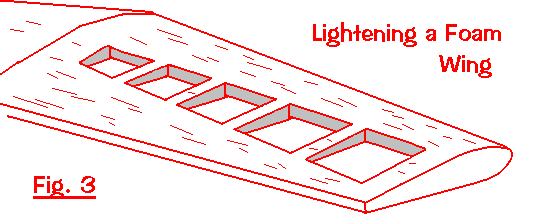
FOAM WINGS: Foam wings can also be improved upon. Note that using light wood for wing skins and minimal glue applies here, too.
Consider that the actual bending loads on the wing are greatest at the center, ranging down to near zero at the tips. So strength can be tapered off as we go out to the tips. Skin and foam may be cut away increasingly progressing outboard toward the wingtips; this is best done behind the thick point on the wing. [See fig. 3]
BUILT-UP WINGS: The same principles apply; strength (and weight) can be cut out near the tips. Spars can be of thinner stock. Gradually cut the thickness of the webbing to 1/32" out at the wingtip.
Note: The above is fine for flight conditions -- but if you "catch a wingtip" on landing, that's another story!
COVERING: Not all coverings weigh the same! The low-temperature mylars are lighter -- fabric is heavier. Even among the "standard" coverings, the weight varies. (Monocote is lighter than Ultracote, for instance.) Color also makes a difference -- lighter colors are heavier! It takes less pigment to color something black than white! And don't have any large overlapping areas on your covering, that's just wasted weight!
SANDING: Can anything be simpler? The more you sand, the less your plane will weigh! Obviously, this could be overdone -- but at least sand in curved corners when they are shown on the plans. That sawdust may not seem like much weight, but it all adds up.
FUEL PROOFING: Using thick coats of epoxy for fuel proofing adds unnecessary weight to your plane. Try dope, glas-coat, brushed on rustoleum, or equivalent. But don't skip out on fuel proofing. Besides being harmful to your wood and glue joints, soaked-in fuel is heavy! FITTINGS: By all means, use quality, strong fittings (pushrods, clevises, control rods, etc.). But be weight conscious, too, and don't overdo strength to where you add unnecessary weight.
BALANCE: DO NOT ACCEPT adding any lead to a plane! The exception is an ounce or two in the wingtip to balance laterally. Move servos, battery, and even the engine to avoid adding lead to your plane. Bolted or glued in lead is unnecessary weight -and adds extra loads to your airframe. Scale builders may be stuck with this -- quite often scale planes tend to be heavy anyway; adding lead becomes the "last straw" leading to the stall, snap, crash tendencies of some of those planes.
EXOTICA: There are more exotic measures taken to save weight -- usually in larger, more complex aircraft. Modelers use aluminum, carbon and boron fiber, expensive honeycombs, and kevlar to increase the strength-to-weight ratio. All this stuff is expensive, but worth it when performance is the prime consideration.
SAFETY: You must keep in mind that whenever you make changes to a design specification, YOU are now responsible for the aircraft's integrity.
Most model designs are heavily overbuilt -- but it's always going to be up to you to decide what is overbuilt and what isn't. We're not rocket scientists (and neither are the designers!), so don't be afraid to ask an experienced modeler (perferably several!) about modifications that you're not sure of.
Don't be reluctant to experiment! If a ply former seems heavy, try making a duplicate of balsa ply, and compare. Try doing a built-up stab (they're easy, really!) and compare weight and stiffness with the solid version.
FINAL THOUGHT: Keep weight in mind constantly as you build. Would EZ hinges be lighter than the conventional hinge-pin type? Can I use shorter (lighter) bolts than the ones the kit supplied? Can I trim the ends off the engine mount? Is this piece of balsa too heavy?
An ounce here, a half-ounce there -- it all adds up!
Site maintained by QSoftWorks
Last Update: 10/12/97