FROM HORN to HORN
Our radio's servos move the airplanes control surfaces in accordance with our desires. In almost every case, though, there is some linkage between the servo and the control surface; specifically, between the servo's output arm and the surfaces control horn. We usually call this linkage the control rod.
There are several types of rods used for this purpose, each with its own good and not-so-good features. Exactly what type connection you use will depend on what the designer calls for, what you are comfortable installing, or maybe what you happen to have on hand at the time. We'll go through the general types and explain them.
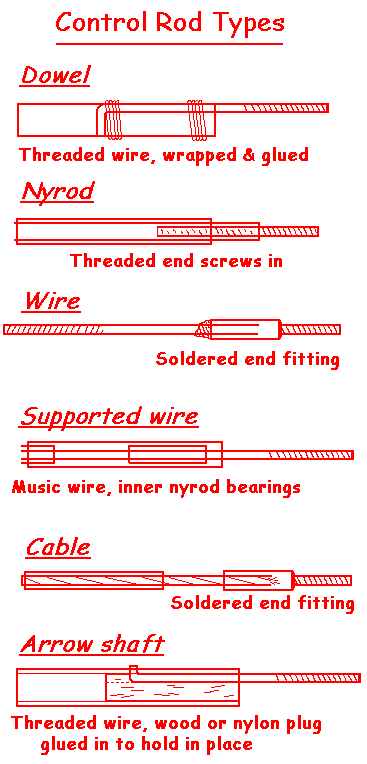
Dowel/Wood Rod: Wooden dowels and balsa square rods are still common on smaller planes and gliders, where there is not much force involved, lightness is critical, and where little sideways forces are expected from aircraft maneuvering. Wire rods are used at the ends, held in place by thread and glue.
Nyrods: These are sold at hobby shops in several grades of stiffness and work beautifully; they're easy to install, the end fittings just screw in, and they will handle curvatures nicely. If curves are made smoothly, there is very little friction. But nyrods do have disadvantages - they must be supported every few inches along their length, they expand and contract with temperature changes, and can have a tiny bit of slop as the nyrod squiggles around in its tube. Great for sport planes, not used much for competition or larger planes.
Wire: Unsupported wire is often used for short links, such as the links between aileron horns and their servo. Also used at the ends of other types of rods to provide for connections to servo and control horns.
Supported Wire: A special method, using music wire for its strength, and nyrods as the support and for bearings, is sometimes used where positive control is needed along with the nyrods ability to bend. The wire is encased in an outer nyrod shell, using short lengths of inner nyrod as support and bearing surface. This system will tolerate slight smooth bending, but does not have the expansion problems that a pure nyrod would. It does require the same periodic supports along its length that nyrods do.
Housed Cable: Cable, running in a plastic housing, is commonly used for throttle control or other uses where loads are light and there will be bends to go around. A throttle cable can go through some amazing contortions and still have little friction. The main disadvantage - cable can stand very little compressive load. If cable is used for nose gear steering, you may have good positive steering when the cable pulls, and mushy, unreliable turns when the cable is pushing. End fittings for clevises must be soldered on.
Pull-Pull Cable: Under the right circumstances and with the right hardware, pull-pull is a neat way to go. Most commonly used for rudder and sometimes for elevator control, pull cables are light, strong, and positive. Used heavily throughout the years on full size aircraft, from flying fleas to B-17s. For model use, cables require a ball bearing servo, and special fittings for adjustment. They also must run reasonably straight. Arrowshafts: The modern version of wood dowels, these are used where strength and precision are paramount, and can be either aluminum or carbon fiber tubing. They require a straight, unobstructed run, and special end fittings must be made or bought to attach wire for clevis attachment. Arrowshaft control rods are often used for pattern and larger planes; they are strong, light, do not expand and contract much if at all, and are very precise in operation.
The accompanying figure illustrates an example of each of the rod types, along with typical attachment methods for wire ends. The actual attachment to servo arms and control horns also has many variations, which will be dealt with in another article.
Site maintained by QSoftWorks
Last Update: 10/12/97