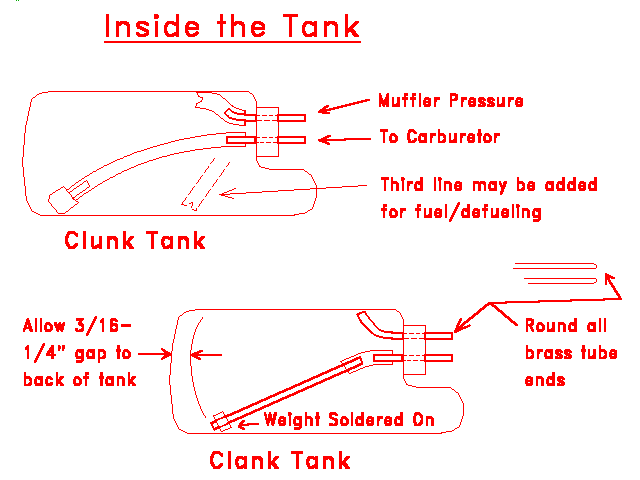
INSIDE THE TANK
-by Clay Ramskill
In the past we've described how a fuel tank should be located and installed in your model. This article will deal with how to set up a new tank and the internal plumbing systems involved.
BEFORE you do much at all with the new tank, look inside, carefully. There may be little pieces of plastic in there, and you must get them out. Also, check around the "seam" inside for flashing - little pieces of plastic that are attached to the seam and stick out into the tank. They can usually be popped off with a screwdriver; if left in your tank, the clunk can hang up on them, leaving you with no fuel going to the engine at an embarrassing moment.
Cut and bend the brass tubing as necessary, noting that you want the tube for the clunk (or clank) pointed at the center rear of the tank; this requires a bend when setting up a slanted front type tank. Cut the the clunk or clank lines so that there is about 1/4" clearance between the rear of the tank and the fuel pickup inlet. The tube for muffler pressure should go right up to the top of the tank - this can be just a long brass tube, or a shorter one with some fuel tube stuck on it. The same applies if you use the third line, for fueling and defueling, only it needs to go to the bottom of the tank.
All the brass tube ends should be filed or sanded such that they are rounded and smooth; otherwise, over time and with some vibration, they will produce holes in the flexible tubing. Ensure all lines are free of crimps, sharp bends, and that the clunk freely falls to all sides of the tank.
The use of the clank (or clapper) set up is a bit more involved, but the clank arrangement prevents the clunk from going up to the front of the tank and jamming there in a sudden-stop situation.
When you're satisfied with the assembled tank, test it! Pump it full, and using the carburetor feed line, pump it empty, looking for any bubbles. Then pump it full again; cap off the other line, and pump some more to pressurize the tank. If there are any leaks, they will be very obvious under pressure! And if there are leaks, wipe the fuel off your face and the floor, and fix'em!
This covers the standard setups for Dubro and Sullivan tanks - note that there are more exotic systems, such as the "uniflow" concept and the internal bladder style tank that are designed to keep more constant fuel pressure to the engine. But that's another story.
GIF for this article.
Site maintained by QSoftWorks
Last Update: 10/12/97