LINKS
Of all the considerable number of little items that cause us problems flying RC, one has continued to stay with us - the link between our control rods and the control horn or servo arm. Despite constant upgrading in the hardware available to us, despite the considerable number of new items in the hobby shop, we still have linkage failures now and then. We may be lucky - only a disconnected throttle - or we may lose a plane if a control link fails.
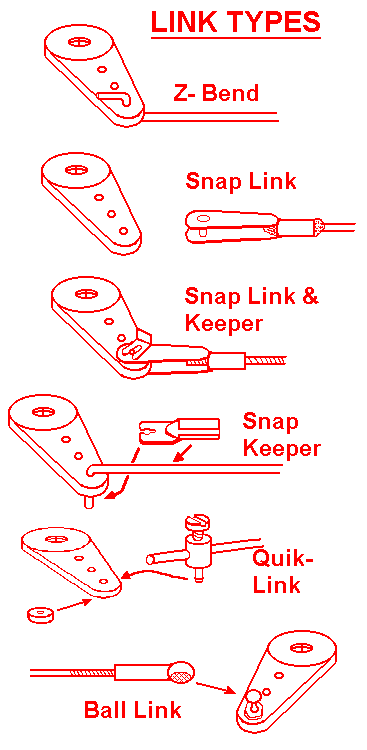
Linkage problems can come from any one or a combination of 3 basic areas - the hardware itself, the modelers (or designers) installation, or from wear and tear over a number of flights. In this article, we'll look at some of the typical types of links and examine good and not so good features of each. See diagram.
The Z-Bend: Used right from the inception of escapements and servos, the z-bended piece of music wire WORKS, and has negligible chance of disconnecting. They're easy, cheap, totally reliable. So why not use them everywhere? First, there is no way to adjust a z-bend; you're stuck with it once installed. They're relatively hard to connect and disconnect, they usually require drilling out the holes on standard servo and control horns, and have a tendency to self-enlarge those holes over time, causing slop. But they're still very useful in some installations - an example would be the connections on an aileron bellcrank hidden in the wing, where you can't see to inspect or get in to adjust anyway. Here the reliability of the z-bend overshadows any other considerations.
The Snap Link: These wonderful little devices are heavily used, and rightfully so. They come in metal solder-on, and nylon and metal screw-on forms, and can very easily be connected or taken loose. The screw-on types, of course, provide for easy linkage adjustment. So where's the problem? For one thing, the lead-in from the control rod must stay pretty close to the plane of rotation of the control or servo arm; while they rotate nicely IN their little holes, any bending in other directions tend to make them self-disconnect. And they can also cause binding if they are overrotated up against the servo or control horns. The nylon types can break, the metal screw-on types can vibrate on the threads, causing radio glitches or even thread failure.
The Snap Link with Keeper: There are several ways to keep the snap link from being wrenched open and off, ranging from a piece of fuel tube slipped over it to some neat little springs that do the same thing. Perhaps the best, though, is the "golden link" which has a metal clip that will keep the link positively closed until YOU want to open it. For positive peace of mind, these are worth the money!
Snap Keepers: These are nylon clips that will (hopefully) keep an L-bended wire onto its control or servo arm. They snap on the wire on both sides of the arm, and in a low-stress installation may be useful. NOT recommended for critical flight controls.
The Quik Link: Perhaps the easiest of all to install, these are indeed quick - just insert into a hole in the servo or control arm, snap on a nylon keeper, and thread thru the wire or cable, and tighten the screw down where you want it. But these links have some pitfalls which may cost you a plane if used on flight controls. First, the nylon keeper "button" that holds the unit on the control or servo arm may come off , allowing the whole thing to disconnect - this is especially true if there is any wrenching or twisting involved. And under those conditions, they may not want to rotate properly, causing binding. Also, especially when used with music wire, the screw can slip. Quik Links are quite often included as kit hardware, but a lot of careful flyers will only use them on throttle cables, if at all.
The Ball Joint: These cost a bit more than other links, and are quite often worth it. A ball joint has it all - positive no slop control, no binding with moderate wrenching or twisting, easily adjusted, and hardly any way they will disconnect themselves. In any situation where the control arm must be free to swing in more than one direction, this is the way to go - the connection to the servo on a strip aileron installation is an obvious example.
NOTE: Almost all the above hardware comes in two popular sizes - 2-56 and 4-40. These figures refer to the wire and thread sizes involved, the 4-40 hardware being much heavier and stronger than the 2-56 versions. The heavier gear should be used in any plane above .60 size, and should even be considered for a fast .60, especially on aileron and elevator control systems.
More information concerning how you set up your control systems will be addressed in future articles. ....Clay
Site maintained by QSoftWorks
Last Update: 10/12/97